Book Review: Nothing North of Delmar by Ellen Barker - A Thought-Provoking Novel About Race, Place, and Change in 1970s St. Louis

In Nothing North of Delmar, Ellen Barker transports readers to 1976 St. Louis, where graduate student Novelle arrives expecting economics to be a world of formulas and certainty. Instead, she discovers the stark realities of the Delmar Divide-a real boundary separating Black North St. Louis from white South St. Louis-and becomes drawn into a struggle over race, power, and neighborhood identity. Blending historical context, humor, and personal growth, Barker delivers a literary novel that feels as relevant today as it would have fifty years ago.
"A powerful and surprisingly timely novel that reveals how the past continues to shape the present."
Some stories pull readers along with plot alone. Others invite us to slow down, reflect, and sit with the deeper questions the story raises.
In this review of Nothing North of Delmar by Ellen Barker, I share what worked for me, where the story stands out, and who I think will connect with it most.
📖 Reader Snapshot
This book may appeal to readers who enjoy:
- ✨ Historical fiction inspired by real events
- ✨ Coming-of-age stories featuring personal growth and self-discovery
- ✨ Literary fiction with meaningful social themes
- ✨ Novels exploring race, class, and community
- ✨ Thought-provoking fiction that connects past and present
Comparable reads: The Help, The Nickel Boys, and The Vanishing Half
About Nothing North of Delmar
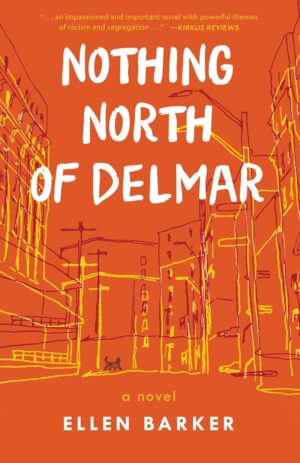 Nothing North of Delmar
 By Ellen Barker
Published by She Writes Press on 04/14/2026
Genres: Historical Fiction, Literary Fiction
Formats: eBook, Paperback
Pages: 344
For fans of Catherine Ryan Hyde and Laurie Frankel, a novel of one young woman’s post-college foray into the adult realities of landlords, economics, and urban politics, set against the Bicentennial summer of 1976.
It's 1976, the Bicentennial year and a watershed moment in America. The draft, the Vietnam war, Woodstock, and the Summer of Love are long gone. Tie-dye is out, and everyone has cut their hair. The Civil Rights Act has passed, the Equal Rights Amendment is just a few states from ratification, Roe v. Wade is firmly enshrined, and closet doors are creaking open. The sixties have changed the world.
Only they haven’t, as Novelle is about to find out.
At this moment, she arrives in St. Louis to start graduate school in economics, a clear-cut field of mathematic problem sets with answers. Except, it’s not. Almost immediately, she discovers that Delmar Boulevard is a Great Wall of China separating St. Louis into Black North and white South, and that economics is the mortar between the bricks. She gets caught up in unraveling a plan to “take back” a Black neighborhood that has leaked over the divide. By the time she finishes her degree, she is getting hate mail and death threats. But she’s also come into her own as a force for change. A satirical, witty look at a slice of history that still resonates today.
Reader Resources
Explore ratings, reviews, and more:
Review at a Glance
| Genre | Historical Fiction, Literary Fiction |
| Themes | Coming-of-Age, Race & Community, Social Justice |
| Setting | 1976 - St. Louis, MO |
| Length | 344 Pages |
| Content Rating | PG-13: No sex, little profanity, but themes of racism and adulting. |
| My Rating | ⭐⭐⭐⭐✨ |
Interested in learning more about the types of books I feature? Visit my How I Choose Books page for a behind-the-scenes look at my selection process.
Quick Take: A thoughtful historical novel that examines the lingering effects of segregation through the eyes of a young woman finding her voice in 1970s St. Louis.
Content Considerations: Themes of racism, housing discrimination, segregation, prejudice, social injustice, political conflict, threats, and racial tension.
What begins as a graduate student's search for answers becomes a fascinating exploration of the forces that shape communities, opportunities, and lives. These are the elements that resonated most with me while reading Nothing North of Delmar.
My Thoughts
One of the aspects I appreciated most about Nothing North of Delmar was the way Ellen Barker transforms a real location into something much larger than a backdrop. Delmar Boulevard is not simply a street in St. Louis-it becomes a visible reminder of the social and economic forces that have shaped communities for generations. Through Novelle's experiences, readers see how housing, economics, and public policy can create divisions that extend far beyond physical boundaries. The result is a story that feels grounded in history while remaining deeply relevant to contemporary conversations.
Although the novel is set in 1976, its themes never feel confined to the past. Barker explores the lingering effects of racism, segregation, and discrimination with a thoughtful touch, highlighting how many of the challenges faced by the characters continue to resonate today. I found myself reflecting on how often we view social progress as a completed chapter when, in reality, many of these issues remain ongoing. The book raises important questions without becoming preachy, allowing readers to draw their own conclusions while remaining engaged in the story.
What keeps the novel from feeling heavy is Barker's ability to balance these serious themes with warmth, humor, and personal growth. Novelle's journey is not simply an examination of social issues; it is also a coming-of-age story about discovering one's voice and learning when to stand up for what is right. The vibrant portrayal of St. Louis, combined with vivid descriptions that place readers directly in the setting, adds depth and energy to the narrative. Even as the story tackles difficult subjects, it never loses sight of the people and communities at its heart.
I also appreciated that the novel acknowledges the complexity of change. Many books focus on the dramatic transformations of the 1960s, but Nothing North of Delmar examines what came afterward-the struggle to move forward without slipping back into old patterns. That perspective gives the story a unique angle and makes its message particularly memorable.
Overall, Nothing North of Delmar is a thoughtful and engaging work of historical fiction that combines social insight with an accessible, character-driven story. Readers who enjoy novels that explore the intersection of history, community, and personal growth will find much to appreciate here. It earned a solid 4+ star rating from me.
More Ellen Barker Reviews
Ellen Barker is quickly becoming an automatic must-read author for me:
In Conclusion
Nothing North of Delmar is more than a historical novel about St. Louis in the 1970s. It is a thoughtful exploration of how communities are shaped, how divisions persist, and how individuals can become catalysts for change. Ellen Barker blends history, social commentary, and personal growth into a story that remains engaging from beginning to end.
Readers who enjoy historical fiction that examines real-world issues through compelling characters will find much to appreciate here. While the novel addresses difficult subjects, it also celebrates resilience, community, and the belief that progress is possible. The questions it raises about race, economics, and opportunity remain just as relevant today as they were nearly fifty years ago.
If you enjoy character-driven historical fiction that encourages reflection long after the final page, Nothing North of Delmar is well worth adding to your reading list.
Before we wrap up, here's a little more about the author behind the story.
About Ellen Barker
About Ellen Barker

Ellen Barker grew up in Kansas City during a period of demographic upheaval, and she returns there in her novels.
She has a bachelor’s degree in urban studies from Washington University in Saint Louis, where she developed a passion for how cities work, and don’t. She began her career as an urban planner, then spent many years working for large consulting firms, first as a writer-editor and later managing large data systems, jobs-rich in corporate drama, large and small.
She is the author of East of Troost, which introduced readers to the neighborhood where Still Needs Work takes place. She now lives in Los Altos, California, with her husband and their German shepherd, Boris, who inspired the dog in this novel.
Explore more from the author:
Website | Amazon | Goodreads
Thanks for reading. If this sounds like your kind of story, you can explore purchase options below.
Support Local Bookshops
Prefer to support independent bookstores? You can shop Nothing North of Delmar through Bookshop.org below.
Shop Nothing North of Delmar on Bookshop.org
Bookshop also carries Nothing North of Delmar in e-book format.
If the widget does not load right away, you can refresh the page or use the direct Bookshop link above.
Read Nothing North of Delmar on Kobo
View Nothing North of Delmar on Amazon
Happy reading-and thank you for supporting indie authors and stories worth discovering.
Tour dates: June 8 to June 26, 2026. To see the full schedule of stops, visit the
iRead Book Tours - Nothing North of Delmar Tour Page.
Thanks for spending part of your reading time with me today.

Get Friday Finds + Bookish Extras
Join me for Friday Finds, cozy reads, and bookish discoveries delivered straight to your inbox.
From your most comprehensive review I understand that a lot of research put to great use went behind this novel 🙂 And the cover is striking.