Delaware Behaving Badly Book Review | True Crime with History, Context, and Consequence
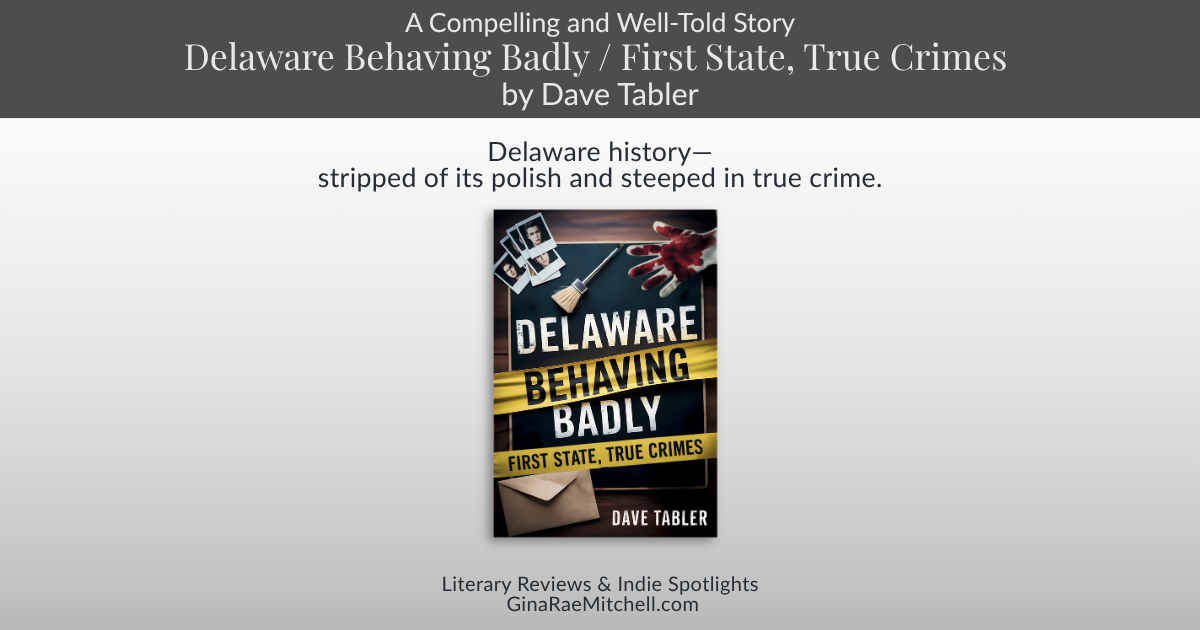
True crime has a way of pulling back the curtain on places we think we understand-and sometimes, the quietest states hold the most surprising stories. Delaware Behaving Badly takes readers beyond the postcard version of the First State and into a past shaped by scandal, corruption, and crimes that once made headlines but have since faded from memory.
With that in mind, here's a closer look at what this true crime collection has to offer.
About Delaware Behaving Badly
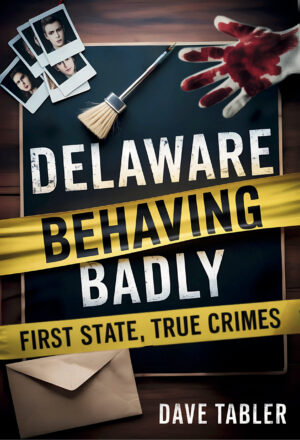 Delaware Behaving Badly: First State, True Crimes
 By Dave Tabler
Published by Independently Published on December 2025
Genres: Adult Non-Fiction 18+, True Crime
Formats: Audiobook, eBook, Paperback
Pages: 286
Murder, scandal, betrayal, and deceit-Delaware has never been as quiet as its size suggests. Delaware Behaving Badly opens the case files of the First State and reveals stories of crime, corruption, and human folly that shaped communities and haunted memories. These are true accounts, pulled from newspapers, court documents, and eyewitness testimony, that show how ordinary people stumbled into extraordinary-and often disastrous-moments.
Readers will encounter jealous lovers whose passion turned violent, fraudsters who built castles of lies, officials who abused the public trust, and families caught in the aftermath of sudden tragedy. Some stories remain unsolved mysteries, their questions echoing across the decades. Others culminate in dramatic courtroom showdowns where reputations crumbled and verdicts set precedents. Each account is both a window into Delaware's past and a timeless study of human behavior pushed to its limits.
The book unfolds as a series of sharply drawn narratives. One chapter pulls readers into a nineteenth-century murder trial where public opinion divided towns along bitter lines. Another follows a confidence man whose schemes entangled the unwary and left local banks reeling. Yet another describes crimes of passion that destroyed households and left behind whispered legends. Woven together, these stories remind us that Delaware's history cannot be told solely through governors and generals. It must also include those who bent or broke the law.
Delaware may be the second smallest state, but its record of scandal is long and colorful. Its compact size meant that crimes quickly became community affairs. A theft in Wilmington could make headlines in Dover by the next morning. A killing in a rural crossroads could ripple outward until the entire county debated guilt and innocence. In such a close-knit place, every misdeed felt personal, every arrest a public event. This intimacy gives the stories in Delaware Behaving Badly unusual power. They do not feel distant. They feel as though they happened to neighbors you might have known.
True crime draws us because it combines suspense with recognition. We read to understand motives, to trace evidence, to watch justice unfold-or fail. At the same time, we see temptations and jealousies that drive people to extremes. The men and women in these pages are not monsters. They are human beings who made choices that shocked those around them and altered the course of their lives forever.
Unlike crime fiction, these stories require no invention. They come from archived newspapers, court records, and diaries that preserve the raw details of Delaware's darker past. Yet the writing is designed for a broad audience, not for specialists. Each chapter moves briskly, carrying the reader into a new case and unfolding it with a storyteller's eye for drama and character. The goal is not simply to recount facts but to bring history alive through narrative.
Delaware Behaving Badly will appeal to true crime enthusiasts who love mysteries rooted in fact, to history readers curious about the Mid-Atlantic, and to anyone who enjoys well-told tales of human conflict and consequence. It stands as both entertainment and entertaining because the stories are gripping, historical because they show how communities once wrestled with crime, punishment, and morality.
For fans of works like The Devil in the White City or regional true crime collections, this book offers the same mix of suspense, period detail, and reflection on human nature. Delaware's small scale makes its scandals especially vivid, and its overlooked history means these stories will be new to most readers.
In these pages, Delaware misbehaves-and its stories prove unforgettable.
Delaware Behaving Badly Book Trailer
Reader resources:
Curious to learn more or see what other readers think? Explore the book here:
View Delaware Behaving Badly on Goodreads
View Delaware Behaving Badly on StoryGraph
View Delaware Behaving Badly on BookBub
As a regular reviewer of Dave Tabler's Delaware books here on the blog, I'm always happy when I see a new one is released.
Review at a Glance
| Genre | True Crime / Historical Nonfiction |
| Setting | Delaware (various time periods) |
| Length | 286 pages |
| Content Rating | PG + M (murder, rape, kidnapping, violence) |
| My Rating | ★★★★☆ |
Quick Take: A compelling look at Delaware's lesser-known criminal past through well-researched, standalone stories.
Content Considerations:
- Murder
- Sexual violence
- Kidnapping
- Historical crimes and legal injustice
While presented in a journalistic style, some cases may be unsettling for sensitive readers.
Here's what worked for me-and where this collection really stands out.
My Thoughts
This is one of those books that quietly pulls you in and then lingers long after you've finished it.
Each chapter reads like its own mini true crime story, making it easy to pick up and read in short bursts-but don't let that structure fool you. What Dave Tabler does here goes far beyond simple storytelling.
At first glance, you might expect sensationalism. The cases themselves certainly have that potential. But instead of stopping at the crime, Tabler digs deeper into the why and the what came next-the societal ripple effects, the institutional failures, and, sometimes, the reforms that followed.
It's a fairly quick read, but not a light one. Some of these stories stay with you-not just because of what happened, but because of what they reveal about human behavior, power structures, and the uneasy balance of justice.
What surprised me most is how clearly the patterns emerge. Whether it's systems being reformed or exploited, there's a throughline that makes this feel less like a collection of isolated events and more like a broader reflection on how justice evolves-and sometimes fails.
If you enjoy true crime tales that ask you to think a little deeper, this one absolutely delivers.
To add a deeper perspective on true crime and why context matters, I'm sharing a guest post from Dave Tabler below.
Guest Post from Dave Tabler
On true crime, context, and why the aftermath matters
I'm a Delaware historian and the author of Delaware Behaving Badly: First State, True Crimes. The book tracks crime in America's first state across nearly four centuries, from colonial-era witchcraft prosecutions to a pediatrician who abused hundreds of children. Self-publishing meant nobody told me which stories were too dark or too complicated to include. I included them all.
Recently I read a Paul Elie essay in The New Republic, "Nonfiction Publishing, Under Threat, Is More Important Than Ever." Elie notes that 40% of Americans didn't read a single book in 2025, and that publishers are responding by pulling back on serious nonfiction. He argues this is exactly the wrong response at exactly the wrong moment. I agree. But I'd go further.
TikTok, YouTube, Instagram, and Facebook are packed with crime content - more every day. These platforms earn their revenue from advertising. Keeping users on-site as long as possible is the engine of that business model. For crime content, that means optimizing for the thing that holds eyeballs: a decapitation, a kidnapping, a monster. The algorithm rewards sensation and punishes context.
I understand the appeal. On the surface, those are exactly the kinds of stories Delaware Behaving Badly delivers. But here's what social media crime content will not give you: the aftermath. The context.
A sixty-second video gives you the horror. A book gives you the policy change born from that horror.
When pediatrician Earl Bradley was finally unmasked after abusing hundreds of Delaware children over fifteen years, the story didn't end with his conviction. It ended with Delaware overhauling its entire system for monitoring the behavior of medical professionals. That reform matters - it protects children right now, and reflects fifteen years of institutional failure that made it necessary.
William Boggs, a Dover banker who vanished in 1897 with $107,000 of his depositors' money, is another example. His case forced Delaware to tighten banking regulations that protected ordinary citizens for generations. The crime was the sensation. The regulation was the point.
Delaware is small enough that you can't hide the patterns - and a state that has been continuously settled since 1638 has had plenty of time to accumulate them.
But the aftermath isn't always reform. Sometimes institutions use the machinery of justice to produce the opposite of justice. Delaware's witchcraft laws, dating to the 17th century, remained on the books until 1953. By the late 19th century they weren't being used to prosecute magic - they were being used to harass Black residents, Roma fortune-tellers, and Jewish immigrants. The law that looked like protection was functioning as control.
Aubrey McKay, a convicted murderer and rapist, understood exactly how prison officials needed him as an informant. He leveraged that relationship to secure unsupervised furloughs - and committed the bulk of his crimes while on them. He didn't beat the system. He read it.
Citizens who consume history only through social media's crime content get the blood. Rarely the lesson. And the lesson is this: justice systems can reform, or they can be gamed. Developing that eye isn't an academic exercise. When neighbors are dragged off without due process, when people are killed exercising the right to peaceful assembly, the citizen who has never studied how justice gets perverted sees chaos. The citizen who has read history sees a pattern-and patterns can be resisted.
That's why I wrote this book. Not in spite of the age of social media crime content. Because of it.
Meet Dave Tabler
About Dave Tabler

Ten year old Dave Tabler decided he was going to read the ‘R’ volume from the family’s World Book Encyclopedia set over summer vacation. He never made it from beginning to end. He did, however, become interested in Norman Rockwell, rare-earth elements, and Run for the Roses.
Tabler’s father encouraged him to try his hand at taking pictures with the family camera. With visions of Rockwell dancing in his head, Tabler press-ganged his younger brother into wearing a straw hat and sitting next to a stream barefoot with a homemade fishing pole in his hand. The resulting image was terrible.
Dave Tabler went on to earn degrees in art history and photojournalism despite being told he needed a ‘Plan B.'
Fresh out of college, Tabler contributed the photography for The Illustrated History of American Civil War Relics, which taught him how to work with museum curators, collectors, and white cotton gloves. He met a man in the Shenandoah Valley who played the musical saw, a Knoxville fellow who specialized in collecting barbed wire, and Tom Dickey, brother of the man who wrote ‘Deliverance.’
In 2006 Tabler circled back to these earlier encounters with Appalachian culture as an idea for a blog. AppalachianHistory.net today reaches 375,000 readers a year.
Dave Tabler moved to Delaware in 2010 and became smitten with its rich past. He no longer copies Norman Rockwell, but his experience working with curators and collectors came in handy when he got the urge to photograph a love letter to Delaware’s early heritage. This may be the start of something.
Explore more from the author:
Website | Amazon | Goodreads
Delaware at Christmas | From Railways to Freeways | From Freeways to E-ways
Where to Buy
If this one sounds like a fit for your reading stack, you can explore purchase options below.
Support Local Bookshops
Prefer to support independent bookstores? You can shop Delaware Behaving Badly through Bookshop.org below.
Shop Delaware Behaving Badly on Bookshop.org
Also available in ebook format.
If the widget does not load right away, you can refresh the page or use the direct Bookshop link above.
View Delaware Behaving Badly on Amazon
Disclosure: This post contains affiliate links. If you make a purchase through these links, I may earn a small commission at no additional cost to you.
Tour dates: April 20 to May 15, 2026. To see the full schedule of stops, visit the
iRead Book Tours Delaware Behaving Badly tour page.
Giveaway
Enter below for a chance to win-and good luck!
Win an Author-Signed copy of Delaware Behaving Badly: First State, True Crimes
Trouble loading the form? Enter here.
Thanks for spending part of your reading time with me today.
Get Friday Finds + Bookish Extras
Join me for Friday Finds, cozy reads, and bookish discoveries delivered straight to your inbox.
Books sound like great would love to read them in print format so I can review them
Hey Crystal,
Did you ever check into doing virtual book tours? Many of them will send you print copies to review.
Just a thought.